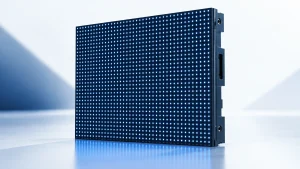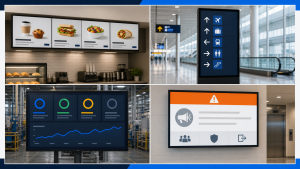
An LED video wall quote should state the cost of a complete usable system—not just the LED panels. Match the active size, native resolution, pixel pitch, installation conditions, and support scope before comparing prices. Then add operating and service costs over the same ownership period.
For scale, Samsung’s December 2023 article described a $38,000–$46,000 price for a particular All-in-One IAC display and discussed installation separately. This is a dated, product-specific public reference, not a September 2026 quote or a typical price for every LED wall. Smaller packages, large custom walls, and different specifications cannot be priced from that example alone.
Make sure you are pricing the same type of wall
This guide concerns direct-view LED walls assembled from LED modules or cabinets, including integrated all-in-one systems. A tiled LCD video wall is a different product category. An “LED TV” usually refers to an LCD television with LED backlighting, not a direct-view LED wall.
Also separate permanent installation from temporary event rental. A rental quote may include equipment and crew for specific dates; ownership must account for storage, service, spares, and support over years. Neither can be compared fairly with a bare equipment price.
The specifications that change the cost
Active area and cabinet layout
Use illuminated width and height, not only a diagonal or an overall dimension that includes trim. Calculate area in the same units: one square meter is approximately 10.764 square feet. A 4 m × 2.25 m image is 9 m², approximately 96.9 ft².
Actual sizes follow module and cabinet increments. Ask for the proposed layout and active dimensions instead of assuming a manufacturer can supply any arbitrary width without changing the configuration.
Pixel pitch and native resolution
Smaller pitch means more pixels within the same active area. At idealized exact dimensions, a 3.84 m × 2.16 m wall at 2 mm pitch has 1,920 × 1,080 pixels; at 1 mm, it has 3,840 × 2,160. That is four times the pixel count—not a rule that the total price must quadruple.
Check whether additional resolution improves your actual task. A nearby spreadsheet reader and a distant audience watching large graphics have different needs. Do not pay for an input labeled “4K” without checking the assembled wall’s native resolution.
Environment, structure, and access
Indoor and outdoor projects have different environmental and installation requirements. Mounting height, access equipment, the supporting structure, and service access can change labor and engineering scope. A wall in an accessible meeting room is not the same installation as one high above a gym floor.
System quality and support
Two walls with the same nominal pitch may differ in calibration, processing, brightness behavior, repair approach, and warranty coverage. Ask what is included to keep the system usable, not just what is included to make it light up on delivery day.
Ask for an itemized installed-system quote
Neoti’s cost breakdown identifies processing, mounting, installation, and ongoing support alongside display hardware. Use those categories to check scope, not to treat one vendor’s component ranges as universal prices.
| Cost group | What should be explicit |
|---|---|
| LED display | Model, exact pitch, active size, cabinet quantity, native resolution, and included power/control components |
| Processing and sources | Controller, supported input/output configuration, playback source, switching, and required licenses |
| Structure and site preparation | Mount, engineering, wall preparation, electrical/data work, and service clearances |
| Delivery and installation | Freight, handling, access equipment, assembly, alignment, commissioning, and cleanup |
| Spares and calibration | Spare types and quantities, compatibility, storage, replacement procedure, and recalibration |
| Training and ongoing service | Operator training, response terms, onsite labor, travel, updates, and exclusions |
| Commercial terms | Currency, taxes, quote validity, delivery terms, payment milestones, and acceptance criteria |
“Included” should identify the item and scope. “Installation included” may still exclude electrical work or a lift. A warranty may cover a replacement component without covering the labor or access equipment needed to fit it.
Use price per square foot only after normalizing scope
For a display-only comparison, divide display-only cost by active area. For an installed-system comparison, divide the full comparable installed cost by the same area. Do not mix the two.
Comparable cost per ft² = cost of the same agreed scope ÷ active area in ft²
As a purely hypothetical arithmetic example, $27,000 of display hardware across 9 m² is $3,000/m², or about $279/ft². If the complete installed project is $45,000, its installed cost is about $465/ft². Both figures can be correct for the same hypothetical project because their scopes differ.
A lower unit price can still be the wrong choice if it changes pixel pitch, removes service coverage, or leaves required work outside the quote. Keep a separate column for exclusions and price those before comparing totals.
Build a three-year ownership budget
All figures below are invented USD assumptions to demonstrate the method. They are not a quote, market average, or extension of the Samsung reference above. The example assumes a 9 m² indoor wall with the listed project scope.
| Item | Assumed cost |
|---|---|
| LED display hardware | $27,000 |
| Processor and playback source | $3,000 |
| Mount and engineering allocation | $4,000 |
| Electrical/data preparation | $2,000 |
| Delivery, installation, and commissioning | $6,000 |
| Initial spares | $2,000 |
| Training and handover | $1,000 |
| Initial installed total | $45,000 |
| Service allocation: $1,200 × 3 years | $3,600 |
| Playback software: $300 × 3 years | $900 |
| Assumed energy: $864 × 3 years | $2,592 |
| Three-year subtotal | $52,092 |
The energy assumption is 1.5 kW of average wall-system demand × 12 hours/day × 320 days/year × $0.15/kWh = $864/year. These are illustrative inputs. Use measured or well-supported operating demand at the intended brightness and content; maximum rated power serves a different purpose and should not automatically become an average energy estimate.
The subtotal excludes tax, financing, additional building cooling, unplanned repairs outside the service allocation, and downtime. Identify these separately where relevant. Do not count a prepaid service plan twice or assume an allowance guarantees every future repair.
Treat service access and spares as buying decisions
Ask how a failed module is replaced in the finished location. “Front service” is useful only if the actual installation permits the required access and procedure. Confirm who performs the work, whether recalibration is necessary, and how long the screen may be unavailable.
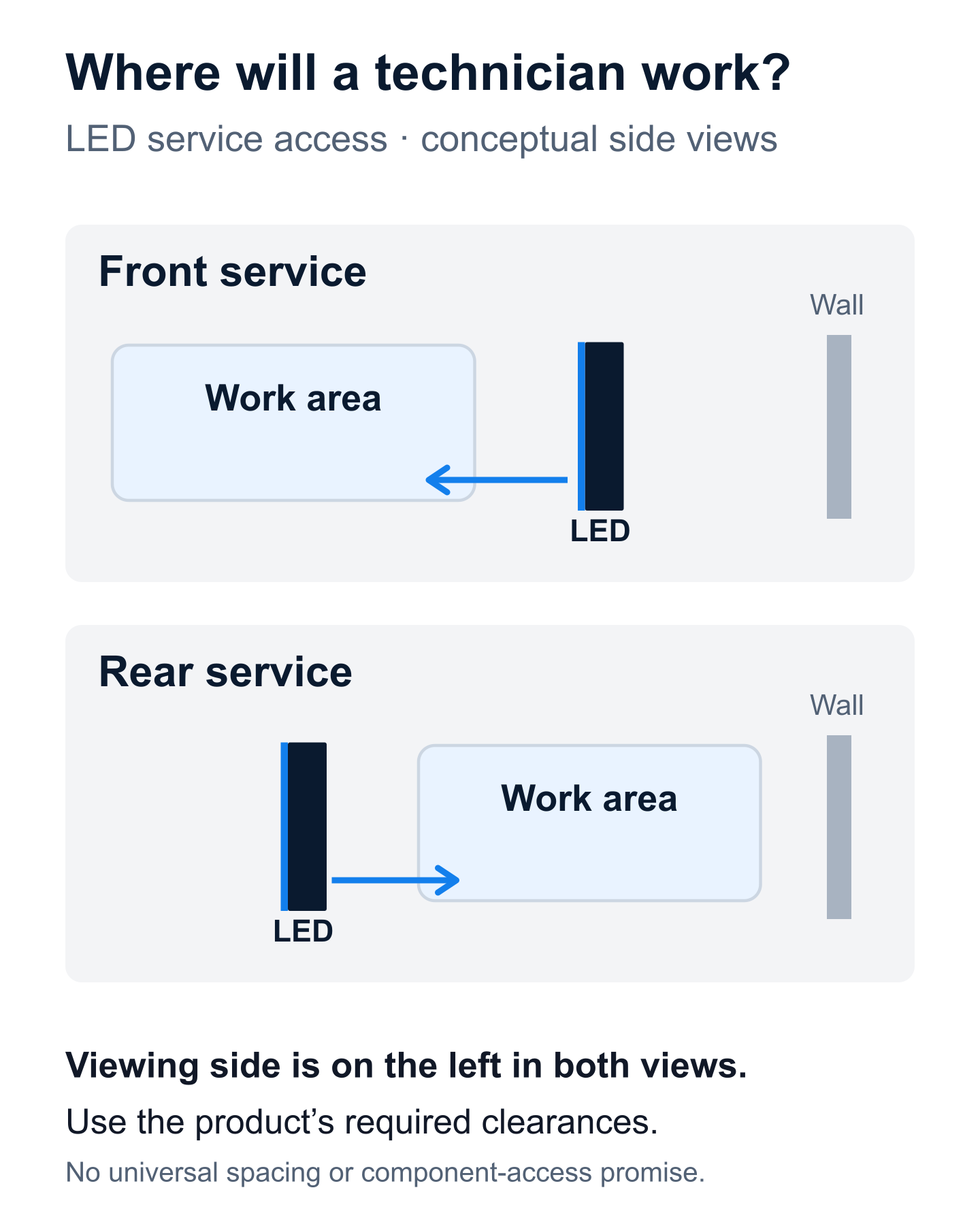
Request a project-specific spare recommendation and compatibility plan. The useful question is not “Do we have some spare LEDs?” but “Do we have the supported components, records, tools, and trained service route to restore this wall?”
If funding covers purchase but not operation, make that visible before ordering. For occasional events, compare an appropriately scoped rental option with ownership. For a permanent information display, compare support coverage and recovery needs over the intended service life.
Send suppliers a brief they can actually price
- Installation address and indoor/outdoor conditions
- Target active image width and height, with available space
- Nearest and farthest viewers, content samples, and camera use
- Daily operating hours and required brightness conditions
- Mounting location, access constraints, and known site-work responsibilities
- Input sources, native-resolution requirement, and processing needs
- Required spares, support period, labor coverage, and acceptance tests
- Required breakdown of inclusions, exclusions, taxes, and delivery terms
Then compare like-for-like totals. If one bidder changes the proposed specification, evaluate the change openly rather than treating the resulting lower number as an equivalent offer.
Common LED wall cost questions
Can a supplier price a wall from its dimensions alone?
They can offer a preliminary assumption-based budget, but a meaningful quote also needs pitch, use, installation conditions, processing, and service scope.
Does a finer pitch always justify its premium?
No. It needs to improve the intended viewing task. Test representative content at the real positions before deciding.
What is the most important number to compare?
The total for an agreed, equivalent scope over an agreed period. Panel price, installed cost, and lifetime cost answer different questions; keep all three clearly labeled.